

Toby Altman and the Art of Making Space
April 14, 2026
- RCAH faculty member and Center for Poetry Director Toby Altman centers creative storytelling, engagement, and relationship-building to create learning spaces rooted in trust.
- Altman’s commitment to student voice, mentorship, and learning is a collaborative, evolving process.
- Student enthusiasm prompted a course devoted to poets’ theater, culminating in the Festival of Poets’ Theater, which will be held in RCAH on April 22-23, 2026.
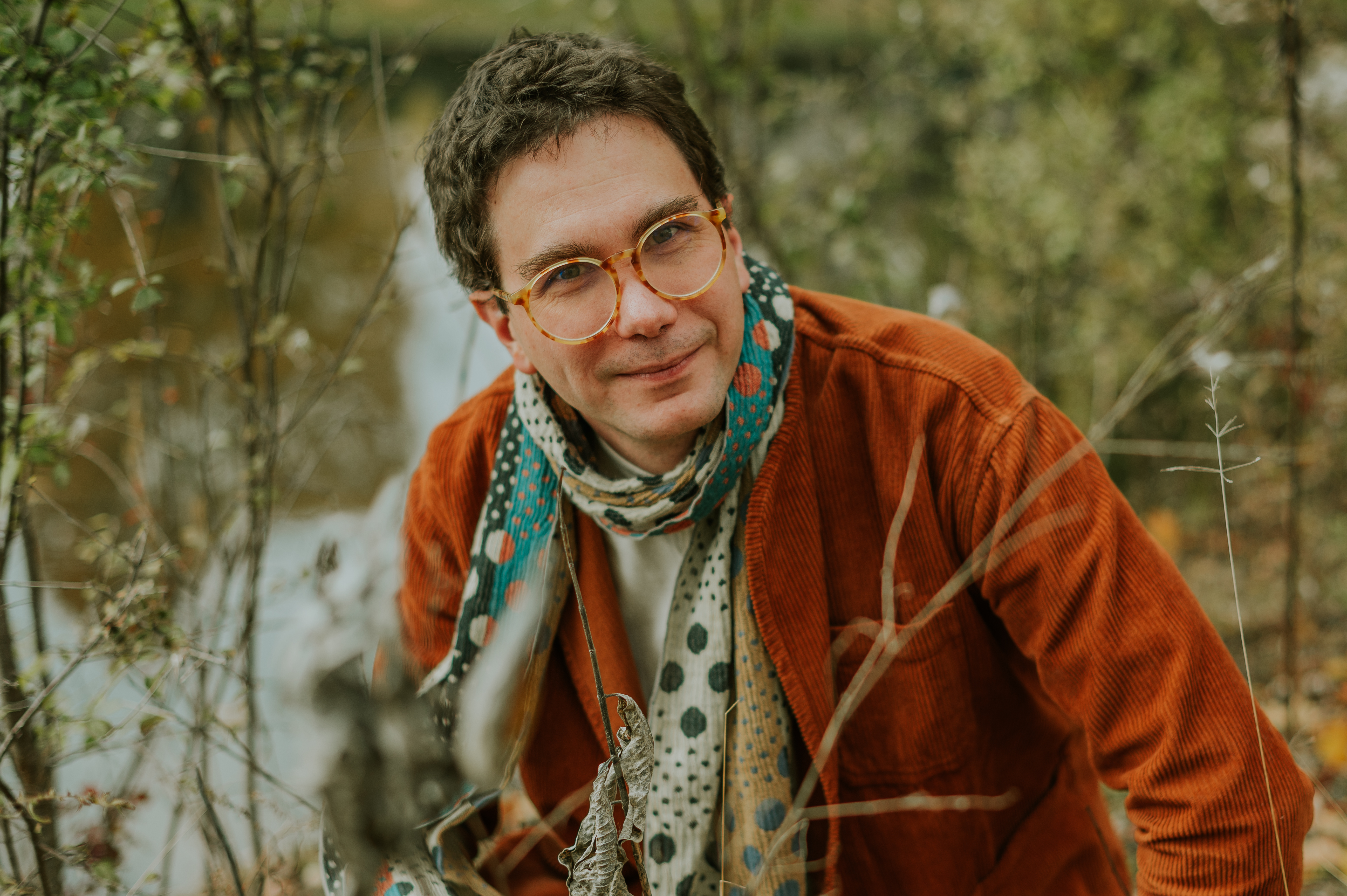
Toby Altman. Photo courtesy of Toby Altman
By Jess Watley ’27, RCAH Senior Communications Intern
Poetry does not always announce itself as poetry. Sometimes it appears as a hallway you’ve walked a hundred times before, suddenly noticed. Sometimes it sounds like a question a student asks that refuses to let you move on. Sometimes it looks like a theater filling, slowly, with people who didn’t expect to find themselves there all together.
For Toby Altman, assistant professor and director of the Center for Poetry at the Residential College in the Arts and Humanities (RCAH) at Michigan State University, poetry happens in those moments.
Altman came to RCAH with a deep commitment to the liberal arts, shaped by his own education and years of teaching at small colleges. At RCAH, teaching doesn’t end when the semester does. Students reappear years later, carrying earlier lessons into new contexts, reshaping them, testing them. There is a unique view here—one that values mentorship as an evolving relationship rather than a single exchange. “Having an expansive family at a small residential college,” Altman termed it, when asked what he enjoys about such relationships.
That long view also defines Altman’s work beyond the classroom. Before arriving at MSU, he spent years organizing readings, festivals, and creative writing events—often as volunteer labor, fueled by belief rather than institutional support. That work comes alive at a place like RCAH and MSU, becoming central to Altman’s work rather than supplemental. The Center for Poetry, under his direction, is more than a venue for visiting writers; it’s a meeting place where students, faculty, poets, and community members encounter one another through shared love for the art.
“Since coming to RCAH, Toby has brought invigorative programming to the classroom and Center for Poetry.” Interim Dean Glenn Chambers says. “The students are benefiting greatly from having him as a professor and a mentor,” he expounds.
Teaching, Altman said, has fundamentally reshaped his relationship to poetry itself. Familiarity breeds contempt, but students disrupt that process. They ask why a line break matters, how an image works. In answering, Altman finds himself returning to the reasons poetry mattered to him in the first place which, he said “makes a sense of the world” for him.
That openness to rethinking form carries into his own writing, which often engages architecture and place. Architecture, unlike poetry, exists, according to Altman, “unavoidably in public.” It is used as much as it is admired. Writing about buildings requires presence—moving through space, lingering, observing, writing amid other people who may never know they’ve entered a poem. Altman describes this as a kind of collaboration between poet and structure, between language and lived space.
There is also resistance embedded in that choice. Architecture is famously “hard” to write about—so much so that the difficulty has become cliché, according to the 2012 book “Writing about Architecture.” But for Altman, that sense of impossibility is precisely the point.
East Lansing, he acknowledged, is full of places that could invite that kind of attention. But as he works on finishing the third book in his planned architectural trilogy (Discipline Park, the first, was published in 2023 by Wendy’s Subway), he finds himself hesitating. Some local places, he says, are “restorative rather than generative”—they “soften you without demanding immediate translation.” MSU’s campus holds many of these spaces, and they are not always poems themselves, but they make poems possible through inspiration.
That sensibility is patient, attentive, and resistant to easy conclusions and shapes how Altman imagines community-building at RCAH, especially with the impending merger of RCAH into MSU’s College of Arts & Letters.
“Longstanding partnerships, once informal, now have the chance to deepen, and the Center for Poetry’s relationship with the Creative Writing Department, for instance, has grown without diminishing the shared history and relationships of RCAH,” he said.
Beyond campus, those connections extend outward. Collaborations with organizations like the Lansing Poetry Club have already borne fruit, including the relaunch of the Poets Roundtable conference and the participation of Michigan Poet Laureate Melba Joyce Boyd.
If there is a model for how Altman envisions the Center for Poetry’s future, it may be found in a project unfolding this semester.
In RCAH 336: Poets’ Theater—a course born from Altman’s RCAH 235 course where students’ interest in theatre and poetry’s liminal space—introduced poetry through its relationship with other art forms. Their enthusiasm prompted an entire course devoted to the form, culminating in the Festival of Poets’ Theater, which will be held in the RCAH theater this April 22-23, 2026. Students will perform original plays for one another, while the Center for Poetry debuts “Killanova,” a newly commissioned work by Joyelle McSweeney, one of the most prominent living practitioners of poets’ theater. The play—written specifically for RCAH—will premiere as part of the festival.
Altman describes this as the work he wants to keep doing: creating original projects that grow directly out of what students are already exploring, allowing programming to fulfill possibilities first encountered in coursework. Poetry, in this vision, is not isolated. It’s embedded. It happens where space becomes something more than background.
In the end, that may be the quiet argument running beneath all of Altman’s work—that poetry is less about mastery, but attention. Less about certainty, but presence. It happens when someone slows down long enough to notice where they are and who they’re with, resulting in the observance of things that refuse to be easily named.
As Altman wrote in a recent issue of Annulet Poetics Journal:
As I recite—or fail to recite—Sonnet 73 to my unborn child, I am trying to teach her something she already knows about language. The first thing she knows about language. That it is opaque, impenetrable, ungiving of itself. It is what poetry teaches us about language.
Stay tuned for more info on The Festival of Poets’ Theater, scheduled for the evenings of April 22 and April 23, 2026.