

Scot Yoder, Longtime RCAH Faculty Member, Appointed Its Next Leader
February 2, 2026
By Morris Arvoy
Scot Yoder has been named the next leader of the Residential College in the Arts and Humanities (RCAH) at Michigan State University. A longtime RCAH faculty member who has been with the College since it first opened, Yoder assumed his new duties as RCAH director on January 1, 2026. He was appointed to the position by Thomas Stubblefield, Dean of MSU’s College of Arts & Letters, following a deliberative process facilitated by RCAH’s Faculty Advisory Committee.
RCAH will integrate officially with the College of Arts & Letters to become the School of Residential Community-Engaged Arts and Humanities (RCAH) on July 1, 2026. Until that time, Yoder will focus on the work of the integration steering committee as well as meet with chairs and other colleagues in the College of Arts & Letters. Yoder also will collaborate with RCAH's outgoing Interim Dean Glenn Chambers to ensure continuity and momentum during the transition into the College of Arts & Letters.
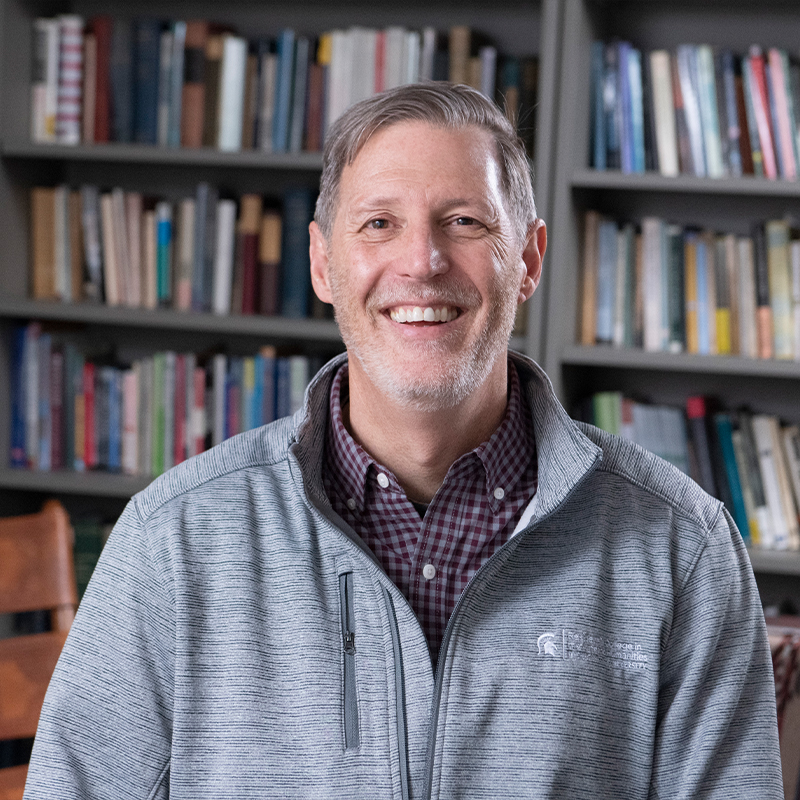
“Dr. Yoder brings deep institutional knowledge, long-standing relationships across the community, and a leadership approach grounded in collaboration and trust. His commitment to fully integrating RCAH into the College of Arts & Letters while preserving the distinctive mission that defines the RCAH community positions him well to lead at this moment," Stubblefield said. “I am confident in Scot’s ability to both honor the extraordinary work that RCAH faculty and staff have done and imagine new possibilities for RCAH—and to approach this important work with creativity and care, as we lay a strong foundation for the next phase of growth for RCAH,” Stubblefield said.
A philosopher whose areas of specialization include pragmatism, religious naturalism, and ethics, Yoder’s tenure at MSU spans four decades. He joined the Department of Philosophy as a graduate assistant in 1994 while he was studying for his Ph.D. in philosophy at MSU. He was named visiting assistant professor in the Department of Philosophy in 2001 and received an MSU Outstanding Faculty and Staff Award from the Resource Center for Persons with Disabilities in 2004 and an Excellence in Study Abroad recognition award in 2014 for more than 10 years of leading study abroad programs.
Yoder joined the RCAH faculty in 2007 when the college opened, and served as Assistant Dean for Student Affairs until 2011 and Associate Dean of Students from 2017 to 2022.
“I have had the honor of being part of an ever-changing community of creative and talented students, colleagues, alumni, and community partners, committed to engaging with and learning from one another,” Yoder said. “The merger of the RCAH and the College of Arts & Letters is easily the most significant change to our program since it was established nearly 20 years ago. To all of you who have contributed to this effort, I want to assure you that as we become the School of Residential Community-Engaged Arts and Humanities, our core identity and mission will not change. We will continue to be a student-centered and community-engaged program that employs the arts and humanities to address complex social problems.”
Yoder is a College of Arts & Letters alum, having earned his Ph.D. in philosophy from MSU in 1999. He also has an M.A. from Bowling Green State University and a bachelor’s degree from Goshen College. Yoder currently serves as president of the Institute for American Religious and Philosophical Thought, a position he has held since 2024.
Yoder—who was an undergraduate at Goshen College, earned an M.A. from Bowling Green State University, and completed his Ph.D. in philosophy from MSU in 1999—currently serves as president of the Institute for American Religious and Philosophical Thought, a position he has held since 2024.
Looking ahead to the future with his RCAH coworkers as well as his new colleagues in the College of Arts & Letters, Yoder said, “I look forward to working with everyone as we answer the question, ‘What can we do together that we could not do separately?’”